Skip to content

Petrol from the pump is a mix of many components (over 100) with different properties that determine the performance of the fuel. If left in an open container it will in time evaporate completely, but as it evaporates the make-up of the fuel will change as different chemical components evaporate at different rates. This evaporation also happens in fuel cans anchad tanks and the process of degradation starts the moment the fuel is purchased.
Petrol will generally last for around 3 weeks at summer temperature in a vented fuel tank, after which time the performance will suffer, and it will be best to add fresh fuel to restore the performance. Petrol in a sealed container will last for more than 6 months before the performance suffers too much.
Fuel stored in underground garage tanks is unlikely to degrade much because of the rate of replenishment.
How petrol changes in the machines fuel tank.
The lighter components evaporate first, these are the chemicals that provide valuable octane benefits on starting from cold. These are very volatile and compose most of the fuel/air mix during initial start-up, but when they are depleted by evaporation the mixture becomes lean, causing higher temperatures, detonation, pre-ignition and piston damage, especially in small high revving two-strokes such as brush cutters and chainsaws.
The fuel that remains when the volatile parts have gone has a higher density, as well as a higher octane, but as it is not as volatile, cold starting is impaired. Because carburettors meter fuel by volume the mixture now becomes rich because of the extra amount of fuel in the denser liquid. This richness will cause plug fouling and blocked exhaust ports due to carbon deposits, but the lack of volatile octane will suppress full revs.
So, in short, marginal fuel will result in hard starting and lack of top-end revs and power, but the machine will run once started.
Formation of Gums and Peroxides
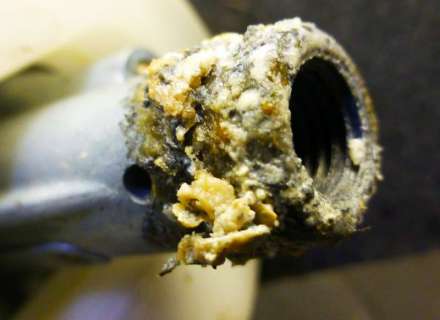
After several months’ storage at summer temperature the petrol will start to form peroxides and gums. The degradation will continue as the fuel ages and the peroxides which form will slowly attack the soft materials in the fuel system. The first to suffer will be the rubber and plastic fuel hoses, which will fall apart, followed by primer bulbs and carb diaphragms. Eventually even the harder plastic of the fuel tank will be eroded as will the aluminium of the carburettor.
The ‘gums’ or ‘varnish’ are solid material which forms and lines the inside of the carburettor, blocking the microscopic bores and jets, thereby effecting the functioning of the carburettor.
Stale fuel is the number one cause of stiff metering diaphragms and the primary cause of carburettor replacement. Gums and varnish will quickly stick the piston rings of a running engine causing expensive failure.
Stale petrol is nothing new
We had the problem of stale fuel long before the addition of Ethanol, it’s just that today’s fuel turns bad much quicker than in the past, in fact, depending on temperature, light and humidity, the fuel can be unusable in as little as 30 days. The ethanol speeds up the process for two reasons: the affinity to water mentioned above and the fact that ethanol is oxygen-rich, which speeds up the oxidation process, which turns petrol stale.
How do we overcome the problem?
1. Keep your fuel fresh and store it in sealed containers in a cool dark and dry place (under the bench on a stone floor, rather than on the bench in front of the shed window). Store your machines in a similar manner.
2. Purchase only enough fuel for 30 days use, and never, ever use fuel over 60 days. You may get away with it, but the chances are that you will have problems.
3. Use a fuel additive such as Briggs and Stratton Fuel Fit which we keep in stock at Cutting Edge Machinery Ltd. If this is added correctly to fresh petrol at the time of purchase, then your fuel should stay usable for up to 90 days. Remember that additives will never be able to rejuvenate old, stale petrol whatever they claim on the bottle!
4. You could try draining your machine before storage; some manufacturers even recommend this, but in our experience, this causes the carb metering diaphragm to shrink and go brittle. It never rehydrates properly.
How to recognise stale petrol.
As petrol ages, it will change noticeably in colour, smell, and viscosity. New petrol, fresh from the garage, will have a pleasant ‘tang’ and will be almost clear, with just a slight colour, but as it ages it will develop an unpleasant smell more akin paint or varnish which will linger on materials or skin for a good while, whilst the colour will deepen considerably. The old fuel will also become much thicker, more akin to noticeably light oil or diesel fuel. Really old petrol will have a very heavy and unpleasant smell and can be very dark in colour, whilst being very thick, more like a liqueur.
What is the best solution?
The best solution by far is to use an alkylate fuel such as Aspen or Stihl Motomix/Motoplus These fuels are derived from petrol but go through a special ‘alkylation’ process, which removes 90% of the unwanted chemicals, leaving around just the 10 essential components. This fuel performs as well (if not a little better) than petrol but is chemically pure (stable) and will never degrade. Fuel lines, tanks and carburettors will not be attacked by this fuel and the machine can safely be stored for years with the same fuel with no detriment.
In addition, the clean burning nature of the fuel will ensure that the internal workings of the engine stay clear of any gums, varnish, or carbon residues.
Alkylate fuel is by far the best, and in stock at Cutting Edge Machinery